Job interviews can be nerve-wracking. Whether you're applying for your first job or are a seasoned professional seeking a career change, interviews are high-stakes moments that can determine your future. Preparation is the key to confidence and success. The better prepared you are, the better you'll perform—and the more likely you'll land the job.
In this ultimate guide, we’ll cover everything you need to know to prepare for a job interview and ace it—from pre-interview research to post-interview follow-ups. Whether your interview is online, over the phone, or in-person, these proven strategies will help you present your best self.
1. Understand the Job Description Thoroughly
Before anything else, read the job posting carefully—several times. Highlight:
- The core responsibilities of the role.
- The required and preferred qualifications.
- Any skills or experience that are emphasized repeatedly.
This helps you understand exactly what the employer is looking for and lets you tailor your answers accordingly. Take note of keywords and incorporate them into your preparation.
Tip: If you’re using the same resume for all jobs, tweak it slightly for each interview to highlight the most relevant experiences and accomplishments.
2. Research the Company
Learning about the company is crucial. You want to show that you’re genuinely interested and have taken the time to understand their mission, culture, and business goals.
Here’s what to look for:
- Company mission and values
- Products or services
- Recent news or milestones
- Competitors and industry trends
- Culture and work environment
Use the company’s website, LinkedIn page, and recent press releases. You can also read employee reviews on platforms like Glassdoor or Indeed.
Why it matters: Interviewers appreciate candidates who demonstrate interest in the company. It shows initiative, preparation, and alignment with their values.
3. Know Your Resume Inside Out
Expect the interviewer to ask you questions about your resume. Be ready to discuss:
- Past job roles and responsibilities
- Specific accomplishments and metrics
- Career transitions or gaps
- Skills you’ve listed
Prepare brief but compelling stories for each key experience. Use the STAR method (Situation, Task, Action, Result) to structure your answers and demonstrate impact.
4. Prepare Answers to Common Interview Questions
While you can’t predict every question, many interviews feature similar themes. Practice your responses to the following:
Common Interview Questions:
- Tell me about yourself.
- What are your strengths and weaknesses?
- Why do you want to work here?
- Why should we hire you?
- Tell me about a time you faced a challenge at work.
- Describe a project you’re proud of.
- Where do you see yourself in five years?
- Why are you leaving your current job?
Pro tip: Practice out loud in front of a mirror or record yourself. This helps improve fluency and body language.
5. Prepare Your Own Questions for the Interviewer
At the end of most interviews, the interviewer will ask, “Do you have any questions for me?” This is your chance to show curiosity, engagement, and professionalism.
Great questions to ask:
- How do you measure success in this role?
- Can you describe the team I’ll be working with?
- What’s the company culture like?
- What are the next steps in the hiring process?
- What are the biggest challenges facing the team right now?
Avoid asking questions that can be easily answered by visiting the company’s website.
6. Practice, Practice, Practice
The more you rehearse, the more confident you’ll feel.
Practice methods:
- Mock interviews with a friend or mentor
- Record yourself answering questions
- Use AI interview simulators available online
Focus on clarity, tone, eye contact (in-person), and posture. For virtual interviews, test your camera and microphone ahead of time.
7. Choose the Right Outfit
Dress professionally, even if the interview is virtual. Your attire should match the company's dress code, but it's always safer to be slightly overdressed than underdressed.
Guidelines:
- For formal industries (finance, law, etc.), wear a suit or formal attire.
- For startups or creative fields, smart casual may be acceptable.
- Ensure your clothes are clean, ironed, and fit well.
Avoid flashy jewelry, heavy perfume, or distracting colors.
8. Get the Logistics Right
For in-person interviews:
- Plan your route in advance.
- Arrive 10-15 minutes early.
- Bring copies of your resume, a notebook, pen, and any required documents.
For virtual interviews:
- Test your technology (camera, mic, internet).
- Choose a quiet, clean, and well-lit location.
- Avoid virtual backgrounds unless required.
- Close unnecessary programs on your computer.
Being prepared logistically helps you stay calm and collected.
9. Use the STAR Method for Behavioral Questions
Behavioral questions require you to describe how you acted in specific situations. The STAR method helps you stay organized and impactful.
STAR stands for:
- Situation – Set the context.
- Task – Describe your responsibility.
- Action – Explain what you did.
- Result – Share the outcome.
Example Question: Tell me about a time you handled a difficult customer.
Answer using STAR:
- S: “At my previous job as a customer service rep, we had a customer who was angry about a delayed shipment.”
- T: “My goal was to de-escalate the situation and find a solution.”
- A: “I listened patiently, apologized sincerely, and offered a partial refund and free expedited shipping.”
- R: “The customer appreciated the response and ended up leaving a positive review.”
10. Understand Different Interview Formats
Interviews come in various formats. Understanding what to expect can help you prepare more effectively.
Types of Interviews:
- Phone Interviews: Often the first screening. Smile while speaking—it affects your tone positively.
- Video Interviews: Test your setup beforehand and maintain eye contact by looking at the camera.
- Panel Interviews: Practice addressing multiple people and remember their names.
- Group Interviews: Focus on standing out respectfully and engaging with others.
- Case Interviews: Common in consulting; these test your problem-solving abilities.
- Technical Interviews: Require you to solve problems or write code in real-time.
11. Show Enthusiasm and Confidence
Interviewers are looking for someone who not only has the skills but also genuinely wants the job.
How to show enthusiasm:
- Smile and maintain good eye contact.
- Use energetic but professional language.
- Mention specific aspects of the role or company that excite you.
- Be confident, but not arrogant.
Confidence tip: Think of the interview as a two-way conversation, not a test.
12. Handle Tough Questions Gracefully
Some questions are designed to test your composure.
Examples and tips:
- What’s your biggest weakness?
Choose a real, non-critical weakness and explain how you're working to improve it. - Why did you leave your last job?
Be honest but diplomatic. Avoid negativity. - Tell me about a failure.
Share what you learned and how you improved.
Stay calm, answer honestly, and turn negatives into learning experiences.
13. Mind Your Body Language
Non-verbal cues speak volumes.
Positive body language includes:
- Firm handshake (if in-person)
- Good posture
- Nodding to show engagement
- Open gestures (avoid crossing arms)
- Eye contact (look at the camera if virtual)
Avoid fidgeting, slouching, or looking around the room.
14. Closing the Interview
End the interview on a strong note.
Steps to close effectively:
- Thank the interviewer for their time.
- Reaffirm your interest in the position.
- Ask about the next steps in the process.
- Leave with a firm handshake or polite goodbye.
Example: “Thank you for your time today. I really enjoyed learning more about your team and the role. I’m very interested in contributing to your company and look forward to the next steps.”
15. Follow Up with a Thank You Note
Always send a thank-you email within 24 hours of the interview.
Your note should:
- Express appreciation for the opportunity.
- Mention something specific from the interview.
- Reiterate your interest and qualifications.
Example:
“Dear [Interviewer’s Name],
Thank you for speaking with me today about the [Job Title] position. I enjoyed our conversation and learning more about the exciting work your team is doing at [Company Name]. I believe my background in [Your Field] would allow me to make meaningful contributions to your team. Please don’t hesitate to reach out if you need any further information.
Sincerely,
[Your Name]”
16. Evaluate and Reflect
After the interview, reflect on:
- What went well?
- Where did you struggle?
- What questions were difficult?
- What feedback (verbal or nonverbal) did you observe?
Use this feedback to improve for your next interview.
17. Prepare for Multiple Rounds
Many jobs require several rounds of interviews—initial screenings, technical assessments, behavioral interviews, and final meetings.
Stay consistent in your messaging and tailor your approach as you learn more about the company and team.
18. Be Ready for Salary Discussions
While it’s best to avoid salary talks in the first interview unless the employer brings it up, you should still be prepared.
Tips:
- Research average salaries for the position.
- Know your worth based on experience, skills, and location.
- Be ready to give a range if asked.
Example: “Based on my research and experience, I’m looking for a salary in the range of $60,000 to $70,000, but I’m open to discussing this based on the full compensation package.”
19. Stay Positive Throughout the Process
Even if you feel the interview didn’t go perfectly, maintain a positive attitude. Some interviewers value honesty and self-awareness over perfection.
If you don’t get the job, follow up and ask for feedback when possible. Use each experience as a stepping stone toward the next opportunity.
20. Keep Interviewing
Don’t stop applying and interviewing after one opportunity. Keep practicing and improving. Each interview is a chance to learn and grow.
Conclusion
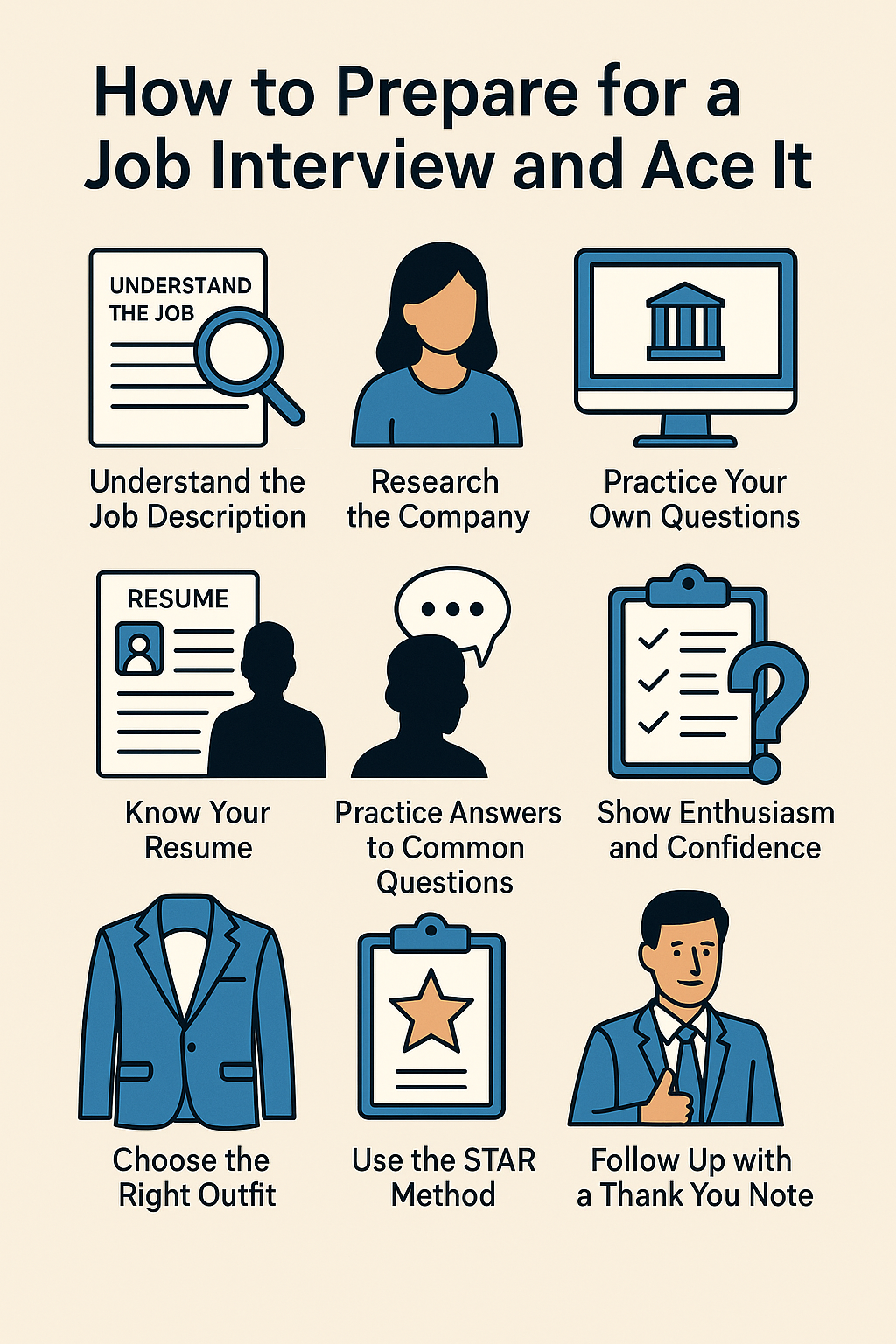
Acing a job interview isn’t about luck—it’s about preparation, self-awareness, and confidence. By researching the company, practicing your responses, dressing appropriately, and following up professionally, you’ll position yourself as a serious and capable candidate.
Remember: interviews are not just about proving yourself, but also about determining if the role and company are the right fit for you. With these strategies, you’ll walk into every interview prepared—and walk out one step closer to your career goals.